

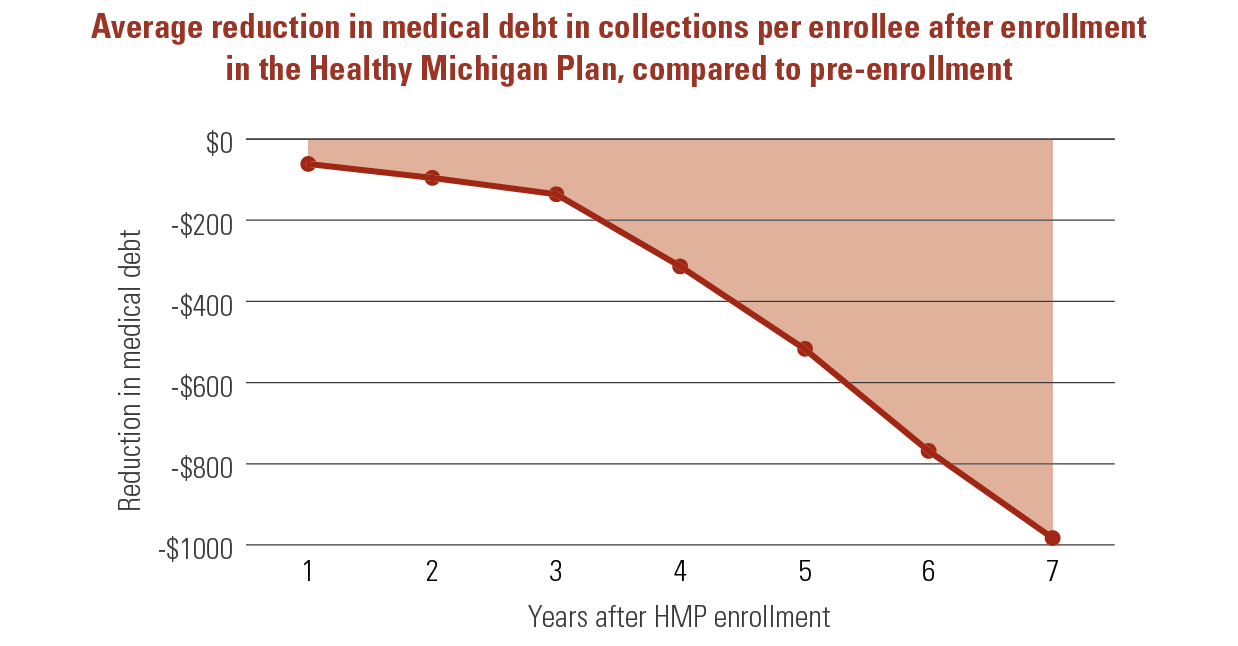
Enrollees in HMP experienced large and significant reductions in medical debt that had been sent to collections. These reductions in medical debt grew over time, reaching an average of $983 less medical debt per enrollee by seven years after enrollment, suggesting that the financial benefits of Medicaid expansion persist and grow over time.
Key Takeaways
- Medical debt is a widespread and growing burden in the U.S. and Michigan, affecting millions of individuals and families.
- Using credit report data, researchers found that enrollment in Michigan’s Medicaid expansion program led to substantial reductions in medical debt sent to collections, along with improved credit scores in the years following enrollment.
- These findings underscore that Medicaid expansion can reduce medical-related financial stress and strengthen the economic stability of low-income individuals, families, and communities.
The Research
In the United States and in Michigan, medical debt has become a pervasive and growing issue affecting many individuals and families.
Recent estimates show that about 20 million people in the U.S. (1 in 12 adults) owe at least $250 in medical debt, totaling more than $220 billion.1 In Michigan, about 690,000 people (1 in 11 adults) report having at least $250 in medical debt. Those who are uninsured for at least part of the year or who have lower incomes are more likely to have medical debt.
The inability to pay medical bills can lead to financial distress, including bankruptcy, poor credit, depleted savings, borrowing money from friends and family, and the need to cut spending on food or other basic needs.2 Some people also forgo or delay medical care, further exacerbating health issues, and others take on extra work or delay education or buying a home. Medical debt disproportionately impacts low-income individuals, people of color, and those in poor health or with complex health needs.
The expansion of Medicaid under the Affordable Care Act (ACA) has improved access to healthcare for millions of people and reduced mortality for low-income people.3,4 However, little is known about Medicaid expansion’s longer-term effects on medical debt and financial stability.
To address this gap in knowledge, our research team used credit report data to look at long-term financial outcomes for people enrolled in Michigan’s Medicaid expansion program, the Healthy Michigan Plan (HMP). This was done as part of the 10 year evaluation of HMP conducted by the Institute for Healthcare Policy & Innovation.
Takeaways from our research
Our study included 575,283 adults ages 26–62 who enrolled in HMP during the first four years of the program, which launched in April 2014. Researchers linked enrollment records to credit report data from a large national credit agency to track their financial trajectories for up to seven years after HMP enrollment.
1
Medicaid expansion was associated with large reductions in medical debt
2
Medicaid expansion was also associated with improved credit scores
There were also large and significant reductions in the proportion of HMP enrollees with subprime credit scores (below 600).
By seven years after enrollment, the share of enrollees with subprime credit scores had fallen by 23 percentage points, reflecting substantial improvements in overall financial stability.

What are the implications for health policy?
This study found that Medicaid expansion under the Affordable Care Act was associated with substantial and sustained improvements in financial outcomes for enrollees in Michigan. Enrollment in HMP was linked to reductions in medical debt sent to collections and improved credit scores. For those with limited incomes, even a relatively small, unexpected expense can be unaffordable. Reducing the amount of medical debt someone has in collections can enhance access to healthcare and support better physical and mental health, while improved credit scores may increase access to affordable loans and housing.
These findings underscore that Medicaid expansion can reduce medical-related financial stress and strengthen the economic stability of low-income individuals, families, and communities. Policies that limit or disrupt Medicaid enrollment may have a negative impact on financial stability among low-income populations.
FEATURED STUDY
Financial Outcomes Among Medicaid Expansion Enrollees. Becker NV, Levy H, Hirth RA, Clark SJ, Tipirneni R, Ayanian JZ. JAMA Network Open. 2026;9(4):e269328. doi:10.1001/jamanetworkopen.2026.9328.
- The Burden of Medical Debt in the United States. Rakshit S, Rae M, Claxton G, et al. Peterson-KFF Health System Tracker. Accessed April 4, 2025. https://www.healthsystemtracker.org/brief/the-burden-of-medical-debt-in-the-united-states.
- Heath Care Debt in the U.S.: The Broad Consequences of Medical and Dental Bills. Lopes L, Kearney A, Montero A, et al. KFF. Accessed April 4, 2025. https://www.kff.org/health-costs/report/kff-health-care-debt-survey/.
- The Effects Of Medicaid Expansion Under The ACA: A Systematic Review. Mazurenko O, Balio CP, Agarwal R, et al. Health Affairs. 2018;37(6):944–950. doi:10.1377/hlthaff.2017.1491.
- Medicaid and Mortality: New Evidence From Linked Survey and Administrative Data. Miller S, Johnson N, Wherry LR. The Quarterly Journal of Economics. 2021;136(3):1783–1829. doi:10.1093/qje/qjab004.
TEAM MEMBERS
Nora V. Becker, MD, PhD, Helen Levy, PhD, Richard A. Hirth, PhD, Sarah J. Clark, MPH, Renuka Tipirneni, MD, MSc, John Z. Ayanian, MD, MPP
For more information about this study, please contact Nora Becker, U-M Assistant Professor of Internal Medicine, at [email protected].
For more information about the Healthy Michigan Plan evaluation, visit ihpi.umich.edu/featured-work/hmp.


